Bhagavad Gita 2.13
Chapter 2, verse 13
Meaning
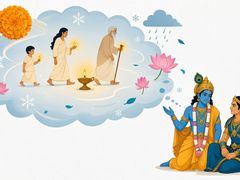
The one who lives in this body passes through childhood, youth and old age. In the same way it passes on to another body. A steady person is not thrown into confusion by that.
The Sanskrit
देहिनोऽस्मिन्यथा देहे कौमारं यौवनं जरा ।
तथा देहान्तरप्राप्तिर्धीरस्तत्र न मुह्यति ॥ १३ ॥
dehino 'smin yathā dehe kaumāraṃ yauvanaṃ jarā
tathā dehāntaraprāptir dhīras tatra na muhyati
Say it
day-hi-no 'smin yuh-thaa day-hay kow-maa-rum yow-vuh-num juh-raa
tuh-thaa day-haan-tuh-ruh-praap-tir dhee-rus tuh-truh nuh moo-hyuh-ti
Word by word
- dehinaḥ
- of the embodied one (the self that lives in a body)
- asmin dehe
- in this body
- yathā
- just as
- kaumāraṃ yauvanaṃ jarā
- childhood, youth, old age
- tathā
- so too
- deha-antara-prāptiḥ
- the passing on to another body
- dhīraḥ
- the steady, wise person
- tatra na muhyati
- is not bewildered by this
 Read it in context: verses 2.13–16Childhood, youth, old age, and what staysWith the story so far, commentary, and today's lesson: Feelings are weather; you are the one standing in it
Another translation and audio recitation: verse 2.13 on holy-bhagavad-gita.org.
Get the readings by email
The verses, the lesson and one thing to try. Free, and separate from new-comic alerts.
We'll ask you to confirm by email first. Unsubscribe from any email.