Bhagavad Gita 1.20
Chapter 1, verse 20
Meaning
Then Arjuna, the son of Pāṇḍu, whose banner carries the monkey Hanuman, looked at Dhṛtarāṣṭra's sons standing in their battle lines. Just as weapons were about to fly, he raised his bow. The sentence runs on into the next verse, where he turns to speak to Krishna.
The Sanskrit
अथ व्यवस्थितान्दृष्ट्वा धार्तराष्ट्रान् कपिध्वजः ।
प्रवृत्ते शस्त्रसम्पाते धनुरुद्यम्य पाण्डवः ॥ २० ॥
atha vyavasthitān dṛṣṭvā dhārtarāṣṭrān kapidhvajaḥ
pravṛtte śastrasaṃpāte dhanur udyamya pāṇḍavaḥ
Say it
uh-thuh vyuh-vuh-sthi-taan drish-tvaa dhaar-tuh-raash-traan kuh-pi-dhvuh-juh-huh
pruh-vrit-tay shus-truh-sum-paa-tay dhuh-noor ood-yum-yuh paan-duh-vuh-huh
Word by word
- atha
- then, at that point
- vyavasthitān dṛṣṭvā
- seeing them drawn up in battle order
- dhārtarāṣṭrān
- the sons of Dhṛtarāṣṭra
- kapi-dhvajaḥ
- he whose banner bears the monkey (Hanuman), Arjuna
- pravṛtte
- when it was just beginning
- śastra-saṃpāte
- the clash of weapons
- dhanuḥ udyamya
- lifting his bow
- pāṇḍavaḥ
- the son of Pāṇḍu, Arjuna
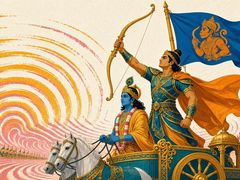 Read it in context: verses 1.17–20Arjuna lifts his bowWith the story so far, commentary, and today's lesson: The same sound lands differently
Another translation and audio recitation: verse 1.20 on holy-bhagavad-gita.org.
Get the readings by email
The verses, the lesson and one thing to try. Free, and separate from new-comic alerts.
We'll ask you to confirm by email first. Unsubscribe from any email.