Kurukshetra Companion, the Bhagavad Gita four verses at a time
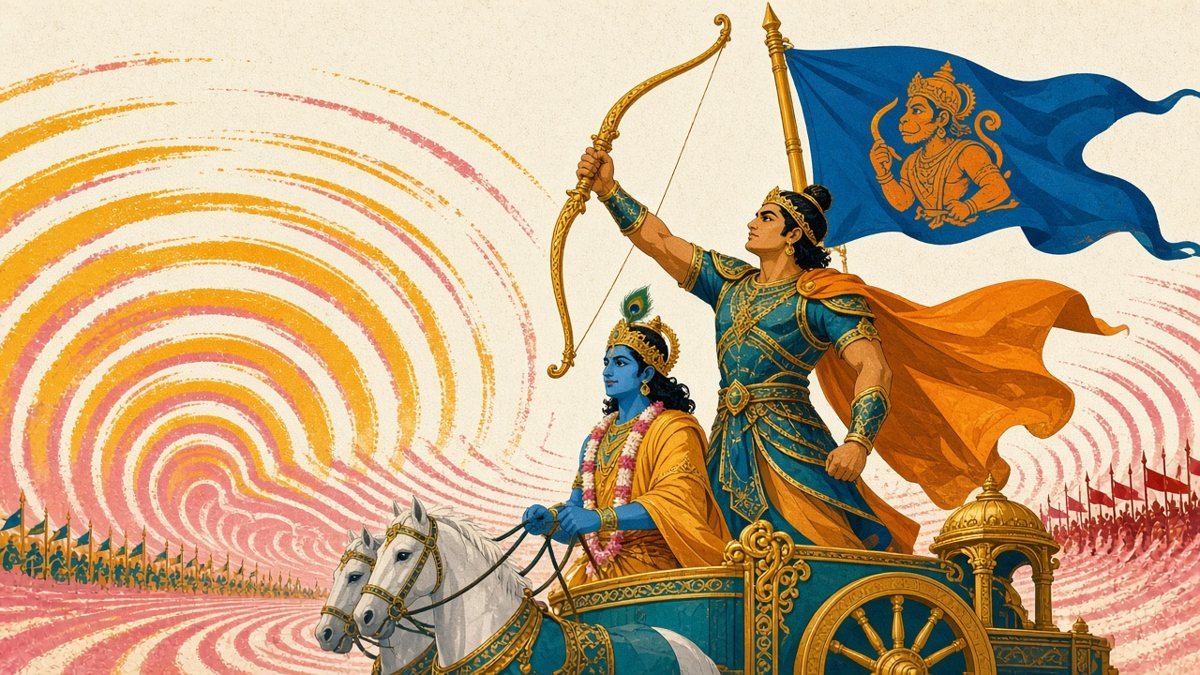
Arjuna lifts his bow
Chapter 1, verses 17–20. About 5 minutes.
Verse 20 of 700 in the full Gita. Chapter 1: 20 of 47.
Where we are
Sañjaya is still describing the battlefield of Kurukshetra to the blind king Dhṛtarāṣṭra. In the previous reading, Krishna, Arjuna and the four other Pāṇḍava brothers each answered the Kaurava din by blowing their own named conch. Now the rest of the Pāṇḍava allies join in, the combined roar shakes the Kaurava side, and Arjuna, his monkey banner flying above him, raises his bow just as the fighting is about to begin.
The verses
-
1.17
The king of Kāśī, a superb archer, and Śikhaṇḍī, a great chariot-warrior, were there too, along with Dhṛṣṭadyumna, King Virāṭa and Sātyaki, who had never been beaten.
Show the SanskritHide the Sanskrit for verse 1.17
काश्यश्च परमेष्वासः शिखण्डी च महारथः ।
धृष्टद्युम्नो विराटश्च सात्यकिश्चापराजितः ॥ १७ ॥kāśyaś ca parameṣvāsaḥ śikhaṇḍī ca mahārathaḥ
dhṛṣṭadyumno virāṭaś ca sātyakiś cāparājitaḥSay it
kaash-yush-chuh puh-ruh-maysh-vaa-suh-huh shi-khun-dee chuh muh-haa-ruh-thuh-huh
dhrish-tuh-dyoom-no vi-raa-tush-chuh saat-yuh-kish-chaa-puh-raa-ji-tuh-huhWord by word
- kāśyaḥ
- the king of Kāśī
- parama-iṣvāsaḥ
- a supreme archer
- śikhaṇḍī
- Śikhaṇḍī
- mahā-rathaḥ
- a great chariot-warrior
- dhṛṣṭadyumnaḥ
- Dhṛṣṭadyumna, commander of the Pāṇḍava army
- virāṭaḥ
- Virāṭa, king of the Matsyas
- sātyakiḥ
- Sātyaki
- ca aparājitaḥ
- and the unconquered one
-
1.18
Drupada, the sons of Draupadī and the mighty-armed son of Subhadrā all blew their conches as well, O lord of the earth, each sounding his own, from every side.
Show the SanskritHide the Sanskrit for verse 1.18
द्रुपदो द्रौपदेयाश्च सर्वशः पृथिवीपते ।
सौभद्रश्च महाबाहुः शङ्खान्दध्मुः पृथक्पृथक् ॥ १८ ॥drupado draupadeyāś ca sarvaśaḥ pṛthivīpate
saubhadraś ca mahābāhuḥ śaṅkhān dadhmuḥ pṛthak pṛthakSay it
droo-puh-do drau-puh-day-yaash-chuh sur-vuh-shuh-huh pri-thi-vee-puh-tay
sau-bhud-rush-chuh muh-haa-baa-hoo-huh shun-khaan dudh-moo-huh pri-thuk pri-thukWord by word
- drupadaḥ
- Drupada, king of Pañcāla
- draupadeyāḥ ca
- and the sons of Draupadī
- sarvaśaḥ
- all together, on every side
- pṛthivī-pate
- O lord of the earth (addressing the king)
- saubhadraḥ
- the son of Subhadrā, Abhimanyu
- mahā-bāhuḥ
- the mighty-armed
- śaṅkhān dadhmuḥ
- blew their conches
- pṛthak pṛthak
- each separately, one by one
-
1.19
That deafening uproar tore through the hearts of Dhṛtarāṣṭra's sons, and it echoed across the sky and the earth.
Text note: The BORI critical edition reads tumulo vyanunādayan, “resounding everywhere”; the traditional text shown here reads tumulo 'bhyanunādayan, “making it echo all around”. The sense is the same: the sound filled sky and earth.
Show the SanskritHide the Sanskrit for verse 1.19
स घोषो धार्तराष्ट्राणां हृदयानि व्यदारयत् ।
नभश्च पृथिवीं चैव तुमुलोऽभ्यनुनादयन् ॥ १९ ॥sa ghoṣo dhārtarāṣṭrāṇāṃ hṛdayāni vyadārayat
nabhaś ca pṛthivīṃ caiva tumulo 'bhyanunādayanSay it
suh gho-sho dhaar-tuh-raash-traa-naam hri-duh-yaa-ni vyuh-daa-ruh-yut
nuh-bhush-chuh pri-thi-veem chai-vuh too-moo-lo-bhyuh-noo-naa-duh-yunWord by word
- saḥ ghoṣaḥ
- that uproar
- dhārtarāṣṭrāṇām
- of the sons of Dhṛtarāṣṭra
- hṛdayāni
- the hearts
- vyadārayat
- tore apart, split
- nabhaḥ ca pṛthivīm ca eva
- both the sky and the earth
- tumulaḥ
- tumultuous, deafening
- abhyanunādayan
- making them echo, resounding through
-
1.20
Then Arjuna, the son of Pāṇḍu, whose banner carries the monkey Hanuman, looked at Dhṛtarāṣṭra's sons standing in their battle lines. Just as weapons were about to fly, he raised his bow. The sentence runs on into the next verse, where he turns to speak to Krishna.
Show the SanskritHide the Sanskrit for verse 1.20
अथ व्यवस्थितान्दृष्ट्वा धार्तराष्ट्रान् कपिध्वजः ।
प्रवृत्ते शस्त्रसम्पाते धनुरुद्यम्य पाण्डवः ॥ २० ॥atha vyavasthitān dṛṣṭvā dhārtarāṣṭrān kapidhvajaḥ
pravṛtte śastrasaṃpāte dhanur udyamya pāṇḍavaḥSay it
uh-thuh vyuh-vuh-sthi-taan drish-tvaa dhaar-tuh-raash-traan kuh-pi-dhvuh-juh-huh
pruh-vrit-tay shus-truh-sum-paa-tay dhuh-noor ood-yum-yuh paan-duh-vuh-huhWord by word
- atha
- then, at that point
- vyavasthitān dṛṣṭvā
- seeing them drawn up in battle order
- dhārtarāṣṭrān
- the sons of Dhṛtarāṣṭra
- kapi-dhvajaḥ
- he whose banner bears the monkey (Hanuman), Arjuna
- pravṛtte
- when it was just beginning
- śastra-saṃpāte
- the clash of weapons
- dhanuḥ udyamya
- lifting his bow
- pāṇḍavaḥ
- the son of Pāṇḍu, Arjuna
Context and commentary
Almost every name in these verses carries a story. The king of Kāśī ruled the old city now called Varanasi. Śikhaṇḍī was born a princess of Pañcāla and is traditionally said to be the rebirth of Ambā, a woman who swore to bring about Bhīṣma's death; because Bhīṣma refuses to fight someone he regards as a woman, Śikhaṇḍī will later be the shield behind which Arjuna brings him down. Dhṛṣṭadyumna, Drupada's son and the Pāṇḍava commander, was said to be born from a sacrificial fire to kill Droṇa, the teacher who had humiliated his father. Virāṭa is the king in whose court the Pāṇḍavas lived in disguise during their final year of exile, and Sātyaki is a Yādava warrior who learned archery from Arjuna. The “son of Subhadrā” is Abhimanyu, Arjuna's teenage son and Krishna's nephew, who will die young in this war. Then come two telling details. Sañjaya tells the blind king, to his face, that the sound “tore the hearts” of his own sons. And Arjuna is called kapidhvaja, “monkey-bannered”: in a well-known Mahābhārata story, Hanuman promised to sit on Arjuna's banner and roar alongside the Pāṇḍavas. Many devotional commentators read 1.19 to mean that the Kauravas were shaken less by the volume than by their own uneasy conscience (interpretation). Śaṅkara says little about the opening chapter, saving his detailed comment for Krishna's teaching in Chapter 2; readers who take the battle as an inner one sometimes see the moment the bow is raised as the point where the mind is fully mobilised, just before the real question appears (interpretation).
Today's lesson
The same sound lands differently
The roar from the Pāṇḍava side is just sound, yet Sañjaya says it tore the Kaurava hearts. The same noise that steadied one army shook the other, and the difference lay in the listeners. This is still the setting of the story, not yet Krishna's teaching, but it is worth noticing in ourselves. When a small thing hits us much harder than it should, it is often because it lands on a worry we were already carrying. Seeing that clearly lets us deal with the real worry rather than with the noise.
Try this today
The next time a message, a tone of voice or a small remark jolts you more than it seems to deserve, pause and finish this sentence in your head: “This hit hard because I was already worried that…”. For example, if a colleague writes “Can we have a quick chat later?” and your stomach drops, you might find you were already worried about a piece of work you rushed. Then take one small step on that actual worry, such as rechecking the work or asking what the chat is about, instead of stewing over the message.
Get each reading by email
The day's four verses, the lesson and one thing to try. Optional, and separate from new-comic alerts.
One email a day. Unsubscribe from any email.
Check the text and listen
- Verses 1.171.181.191.20Translation and commentary on holy-bhagavad-gita.org
- Public-domain translationsacred-texts.com
- Chapter chanting audio (Sanskrit, downloadable)bhagavad-gita.us
- Verse-level interactive audiomiu.edu