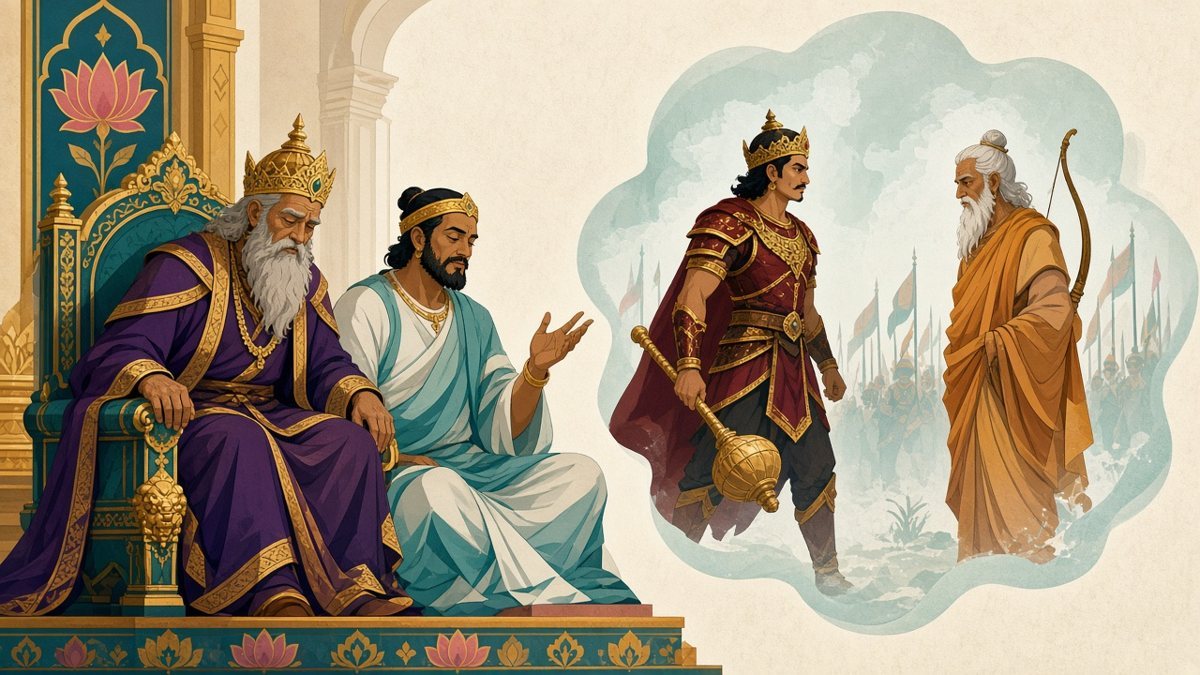
Kurukshetra Companion, the Bhagavad Gita four verses at a time
A blind king asks what happened
Chapter 1, verses 1–4. About 5 minutes.
Verse 4 of 700 in the full Gita. Chapter 1: 4 of 47.
Chapter 1: Arjuna Viṣāda Yoga
Arjuna's Despair, 47 verses
Chapter 1 sets the stage. Two armies drawn from one royal family face each other on the plain of Kurukshetra; the blind king asks for news, the commanders size up their forces, and the warrior Arjuna, seeing relatives and teachers on the other side, collapses in grief. It is called “Arjuna's Despair” because the whole teaching of the Gita begins as an answer to that collapse.
Where we are
Welcome. The Bhagavad Gita sits inside the Mahābhārata, India's great epic about a royal family that tears itself apart. On one side are the hundred Kaurava brothers, led by Duryodhana, sons of the blind king Dhṛtarāṣṭra; on the other, the five Pāṇḍava brothers, sons of his late brother Pāṇḍu, among them the archer Arjuna. After years of rivalry, a rigged game of dice, exile and failed peace talks, both armies have marched to the plain of Kurukshetra. But the Gita opens far from the field, in the palace, where the old king, who cannot see, asks his minister and charioteer Sañjaya to tell him what is happening. The sage Vyāsa has given Sañjaya divine sight, so he can watch the whole battlefield from where he sits.
The verses
-
1.1
dhṛtarāṣṭra uvāca
Sañjaya, my sons and the sons of Pāṇḍu have come together at Kurukshetra, the field of dharma, spoiling for a fight. Tell me: what did they do?
Show the SanskritHide the Sanskrit for verse 1.1
धर्मक्षेत्रे कुरुक्षेत्रे समवेता युयुत्सवः ।
मामकाः पाण्डवाश्चैव किमकुर्वत सञ्जय ॥ १ ॥dharmakṣetre kurukṣetre samavetā yuyutsavaḥ
māmakāḥ pāṇḍavāś caiva kim akurvata saṃjayaSay it
dhur-muh-kshay-tray koo-roo-kshay-tray suh-muh-vay-taa yoo-yoot-suh-vuh-huh
maa-muh-kaah paan-duh-vaash chai-vuh kim uh-koor-vuh-tuh sun-juh-yuhWord by word
- dharma-kṣetre
- on the field of dharma
- kuru-kṣetre
- at Kurukshetra, the field of the Kurus
- samavetāḥ
- gathered together
- yuyutsavaḥ
- eager to fight
- māmakāḥ
- my people (my sons)
- pāṇḍavāḥ
- the sons of Pāṇḍu
- ca eva
- and also
- kim akurvata
- what did they do?
- saṃjaya
- O Sañjaya
-
1.2
saṃjaya uvāca
Sañjaya answered: When Duryodhana saw the Pāṇḍava army lined up for battle, he went straight over to his teacher, Droṇa, and the prince began to speak.
Show the SanskritHide the Sanskrit for verse 1.2
दृष्ट्वा तु पाण्डवानीकं व्यूढं दुर्योधनस्तदा ।
आचार्यमुपसङ्गम्य राजा वचनमब्रवीत् ॥ २ ॥dṛṣṭvā tu pāṇḍavānīkaṃ vyūḍhaṃ duryodhanas tadā
ācāryam upasaṃgamya rājā vacanam abravītSay it
drish-tvaa too paan-duh-vaa-nee-kum vyoo-dhum door-yo-dhuh-nus tuh-daa
aa-chaar-yum oo-puh-sun-gum-yuh raa-jaa vuh-chuh-num ub-ruh-veetWord by word
- dṛṣṭvā
- having seen
- tu
- then, but
- pāṇḍava-anīkam
- the Pāṇḍava army
- vyūḍham
- drawn up in battle formation
- duryodhanaḥ
- Duryodhana
- tadā
- at that moment
- ācāryam
- the teacher (Droṇa)
- upasaṃgamya
- going up to
- rājā
- the king (Duryodhana)
- vacanam abravīt
- spoke these words
-
1.3
Teacher, look at this enormous army of Pāṇḍu's sons. It has been drawn up for battle by Drupada's son, that clever student of yours.
Show the SanskritHide the Sanskrit for verse 1.3
पश्यैतां पाण्डुपुत्राणामाचार्य महतीं चमूम् ।
व्यूढां द्रुपदपुत्रेण तव शिष्येण धीमता ॥ ३ ॥paśyaitāṃ pāṇḍuputrāṇām ācārya mahatīṃ camūm
vyūḍhāṃ drupadaputreṇa tava śiṣyeṇa dhīmatāSay it
push-yai-taam paan-doo-poot-raa-naam aa-chaar-yuh muh-huh-teem chuh-moom
vyoo-dhaam droo-puh-duh-poot-ray-nuh tuh-vuh shish-yay-nuh dhee-muh-taaWord by word
- paśya
- look at
- etām
- this
- pāṇḍu-putrāṇām
- of the sons of Pāṇḍu
- ācārya
- O teacher
- mahatīm camūm
- huge army
- vyūḍhām
- arranged for battle
- drupada-putreṇa
- by Drupada's son (Dhṛṣṭadyumna)
- tava śiṣyeṇa
- your own student
- dhīmatā
- clever, gifted
-
1.4
Over there are heroes and mighty archers, every bit the equal of Bhīma and Arjuna in battle: Yuyudhāna, Virāṭa, and Drupada, a great chariot-warrior. (Duryodhana's list carries on through the next two verses.)
Show the SanskritHide the Sanskrit for verse 1.4
अत्र शूरा महेष्वासा भीमार्जुनसमा युधि ।
युयुधानो विराटश्च द्रुपदश्च महारथः ॥ ४ ॥atra śūrā maheṣvāsā bhīmārjunasamā yudhi
yuyudhāno virāṭaś ca drupadaś ca mahārathaḥSay it
ut-ruh shoo-raa muh-haysh-vaa-saa bhee-maar-joo-nuh-suh-maa yoo-dhi
yoo-yoo-dhaa-no vi-raa-tush chuh droo-puh-dush chuh muh-haa-ruh-thuh-huhWord by word
- atra
- here, in that army
- śūrāḥ
- heroes
- mahā-iṣvāsāḥ
- great archers, wielders of mighty bows
- bhīma-arjuna-samāḥ
- equal to Bhīma and Arjuna
- yudhi
- in battle
- yuyudhānaḥ
- Yuyudhāna (also called Sātyaki)
- virāṭaḥ
- King Virāṭa
- drupadaḥ
- King Drupada
- mahā-rathaḥ
- a great chariot-warrior
Context and commentary
The very first word of the Gita is dharma: duty, rightness, the order that holds things together. Kurukshetra was already holy ground, the “field of the Kurus”, where their ancestor King Kuru is said to have ploughed and performed rites. A popular modern observation is that the text opens with dharma and closes (18.78) with mama, “my”, as if the whole Gita were about “my dharma”. The king's wording is revealing too. He says māmakāḥ, “my people”, and then “Pāṇḍu's sons”, though all of them are his family. Traditional commentators hear anxiety and favouritism in this; some suggest he feared the holy ground itself might sway the outcome or soften his sons' resolve (interpretation). Duryodhana's speech has an edge as well. Droṇa taught archery to both sets of cousins, and the Pāṇḍava army is arranged by Dhṛṣṭadyumna, son of Droṇa's old friend turned enemy, King Drupada. The epic says Dhṛṣṭadyumna was born to kill Droṇa, and Droṇa taught him anyway, so “your clever student” is a pointed jab. Readers take the whole scene in different ways: Gandhi read the battlefield as an allegory for the struggle between good and bad impulses inside each person; Aurobindo insisted the war is real and that the teaching is about acting in the actual world; Śaṅkara's commentary passes quickly over Chapter 1 and begins its main work at 2.10, treating these verses as the setting for Arjuna's grief. One more detail: in the epic, Sañjaya gives this report after ten days of fighting, once the great elder Bhīṣma has fallen, so the Gita is told looking back.
Today's lesson
Notice who you call “mine”
Before a single arrow flies, the Gita lets us overhear two worried men. The blind king doesn't ask what happened to his family; he asks what “my sons and Pāṇḍu's sons” did, splitting one family into mine and theirs in a single breath. Duryodhana, seeing the other army, hurries to his teacher and starts listing the enemy's strengths, with a dig about whom the teacher has trained. Nothing has been decided yet, but the way each man frames the situation already shows his fear. We do the same: “my team” and “that department”, “my side of the family” and “your relatives”, “us” and “the other parents at school”. These verses don't tell us what to do about it yet; for now the practice is simply to hear how our questions take sides before any answer arrives.
Try this today
Pick one disagreement you are part of right now, at work, at home or among friends. Write down the question you keep asking yourself about it, word for word (for example: “Why does the other team always slow us down?”). Underline every “my”, “us” and “them”. Then rewrite the question once without those words (“What would help this project finish on time?”) and notice whether the new question points to a different next step.
Get each reading by email
The day's four verses, the lesson and one thing to try. Optional, and separate from new-comic alerts.
One email a day. Unsubscribe from any email.
Check the text and listen
- Verses 1.11.21.31.4Translation and commentary on holy-bhagavad-gita.org
- Public-domain translationsacred-texts.com
- Chapter chanting audio (Sanskrit, downloadable)bhagavad-gita.us
- Verse-level interactive audiomiu.edu