Kurukshetra Companion, the Bhagavad Gita four verses at a time
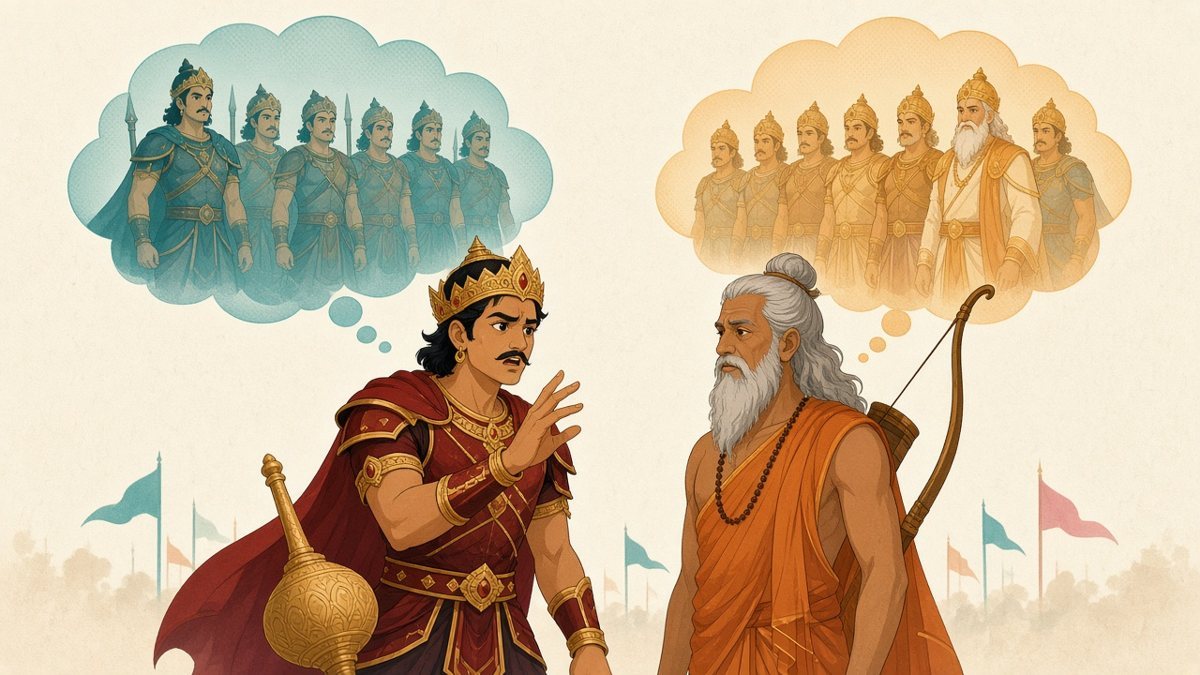
Duryodhana counts his heroes
Chapter 1, verses 5–8. About 5 minutes.
Verse 8 of 700 in the full Gita. Chapter 1: 8 of 47.
Where we are
In the previous reading, the blind king Dhṛtarāṣṭra asked his minister Sañjaya what was happening at Kurukshetra, and Sañjaya, who can see the battlefield through a gift of divine sight, began his report. Prince Duryodhana, leader of the Kaurava side, had hurried over to his old archery teacher Droṇa and started pointing out the great fighters in the Pāṇḍava army. In these four verses he finishes that list, then turns to his own side and names its commanders, beginning with Droṇa himself.
The verses
-
1.5
There are Dhṛṣṭaketu and Cekitāna, and the valiant king of Kāśī; there are Purujit and Kuntibhoja, and Śaibya, a towering figure among men.
Show the SanskritHide the Sanskrit for verse 1.5
धृष्टकेतुश्चेकितानः काशिराजश्च वीर्यवान् ।
पुरुजित्कुन्तिभोजश्च शैब्यश्च नरपुङ्गवः ॥ ५ ॥dhṛṣṭaketuś cekitānaḥ kāśirājaś ca vīryavān
purujit kuntibhojaś ca śaibyaś ca narapuṃgavaḥSay it
drish-tuh-kay-toosh chay-ki-taa-nuh-huh kaa-shi-raa-jush chuh veer-yuh-vaan
poo-roo-jit koon-ti-bho-jush chuh shai-byush chuh nuh-ruh-poon-guh-vuh-huhWord by word
- dhṛṣṭaketuḥ
- Dhṛṣṭaketu, king of the Cedis
- cekitānaḥ
- Cekitāna
- kāśirājaḥ
- the king of Kāśī (Varanasi)
- ca
- and
- vīryavān
- valiant, mighty
- purujit
- Purujit
- kuntibhojaḥ
- Kuntibhoja
- śaibyaḥ
- Śaibya
- nara-puṃgavaḥ
- a bull among men, the finest of men
-
1.6
There are bold Yudhāmanyu and mighty Uttamaujas, Subhadrā's son, and the sons of Draupadī. Every one of them is a great chariot-warrior.
Show the SanskritHide the Sanskrit for verse 1.6
युधामन्युश्च विक्रान्त उत्तमौजाश्च वीर्यवान् ।
सौभद्रो द्रौपदेयाश्च सर्व एव महारथाः ॥ ६ ॥yudhāmanyuś ca vikrānta uttamaujāś ca vīryavān
saubhadro draupadeyāś ca sarva eva mahārathāḥSay it
yoo-dhaa-mun-yoosh chuh vi-kraan-tuh oot-tuh-mau-jaash chuh veer-yuh-vaan
sau-bhud-ro drau-puh-day-yaash chuh sur-vuh ay-vuh muh-haa-ruh-thaa-haaWord by word
- yudhāmanyuḥ
- Yudhāmanyu
- vikrāntaḥ
- bold, daring
- uttamaujāḥ
- Uttamaujas
- vīryavān
- mighty
- saubhadraḥ
- Subhadrā's son (Abhimanyu, Arjuna's son)
- draupadeyāḥ
- the sons of Draupadī
- sarve eva
- every one of them
- mahā-rathāḥ
- great chariot-warriors
-
1.7
But now, best of Brahmins, take note of the finest on our side as well, the commanders of my army. I will name them for you so you have them clearly in mind.
Show the SanskritHide the Sanskrit for verse 1.7
अस्माकं तु विशिष्टा ये तान्निबोध द्विजोत्तम ।
नायका मम सैन्यस्य संज्ञार्थं तान्ब्रवीमि ते ॥ ७ ॥asmākaṃ tu viśiṣṭā ye tān nibodha dvijottama
nāyakā mama sainyasya saṃjñārthaṃ tān bravīmi teSay it
us-maa-kum too vi-shish-taa yay taan ni-bo-dhuh dvi-jot-tuh-muh
naa-yuh-kaa muh-muh sain-yuh-syuh sun-gyaar-thum taan bruh-vee-mi tayWord by word
- asmākam
- of ours, on our side
- tu
- but, now
- viśiṣṭāḥ ye
- those who are the most distinguished
- tān nibodha
- take note of them, know them
- dvija-uttama
- best of the twice-born (of Brahmins)
- nāyakāḥ
- leaders, commanders
- mama sainyasya
- of my army
- saṃjñā-artham
- for your information, so you have them in mind
- tān bravīmi te
- I name them to you
-
1.8
There is you yourself, sir, and Bhīṣma, Karṇa, and Kṛpa, who wins every battle he fights; there are Aśvatthāman and Vikarṇa, and Somadatta's son as well.
Show the SanskritHide the Sanskrit for verse 1.8
भवान्भीष्मश्च कर्णश्च कृपश्च समितिञ्जयः ।
अश्वत्थामा विकर्णश्च सौमदत्तिस्तथैव च ॥ ८ ॥bhavān bhīṣmaś ca karṇaś ca kṛpaś ca samitiṃjayaḥ
aśvatthāmā vikarṇaś ca saumadattis tathaiva caSay it
bhuh-vaan bheesh-mush chuh kur-nush chuh kri-push chuh suh-mi-tin-juh-yuh-huh
ush-vut-thaa-maa vi-kur-nush chuh sau-muh-dut-tis tuh-thai-vuh chuhWord by word
- bhavān
- your honour, you yourself
- bhīṣmaḥ
- Bhīṣma, the family's great elder
- karṇaḥ
- Karṇa
- kṛpaḥ
- Kṛpa
- samitim-jayaḥ
- victorious in battle
- aśvatthāmā
- Aśvatthāman, Droṇa's son
- vikarṇaḥ
- Vikarṇa, one of Duryodhana's brothers
- saumadattiḥ
- the son of Somadatta (Bhūriśravas)
- tathā eva ca
- and likewise
Context and commentary
These verses can read like a roll-call, but almost every name carries a story from the Mahābhārata. On the Pāṇḍava side, “Subhadrā's son” is Abhimanyu, Arjuna's teenage son, who will later die trapped inside an enemy battle formation; the “sons of Draupadī” are the five sons of the Pāṇḍava brothers' shared wife; Kuntibhoja is the king who adopted Kuntī, the Pāṇḍavas' mother, so he is family too. On Duryodhana's side, Aśvatthāman is Droṇa's own son and Kṛpa is Droṇa's brother-in-law, himself a teacher of the princes. Karṇa is the most poignant name: he is secretly the eldest son of Kuntī, born before her marriage and given away, which makes him the Pāṇḍavas' unknown elder brother. In the epic he refuses to fight while Bhīṣma commands, so naming him here is partly hopeful. The order of the list is telling. Duryodhana starts with bhavān, “you yourself”, putting Droṇa ahead of Bhīṣma, the actual commander-in-chief. Many readers take this as flattery meant to bind a teacher whose affection for the Pāṇḍavas, especially his star pupil Arjuna, was well known; calling him dvijottama, “best of the twice-born”, may also remind the Brahmin teacher which side he has chosen to serve (interpretation). The classical commentators, Śaṅkara, Rāmānuja and Madhva, treat Chapter 1 mainly as narrative setting and save their close reading for Krishna's teaching. Readers who take the battle as an inner allegory, as Gandhi did, sometimes see these crowded lists as the many competing forces in a single mind (interpretation).
Today's lesson
When counting becomes calming
Duryodhana's response to fear is to count. First he lists the other side's heroes, name after name, then he turns and lists his own, as if a long enough roll-call could settle the outcome before anything has happened. Taking stock is not wrong; any sensible person checks what they are up against and what they have. But notice the tone: he is talking fast, flattering his teacher, and naming people more to steady himself than to make a plan. We do the same before a job interview, a hard family conversation or a test result, going over and over who is for us, who is against us and what we have in our favour. This early in the Gita there is no teaching yet, only a chance to see the state clearly: the difference between preparing and simply soothing ourselves.
Try this today
Think of one thing you are nervous about right now, such as an interview, a difficult talk with a relative or a presentation at work. Write two short lists, the way Duryodhana does: what worries you on the other side, and what you have on yours. Then mark each line P if it changes something you will actually do, or R if it is only there to reassure you. For example, “I have three good stories about past projects ready” is a P; “I'm probably more experienced than the other candidates” is likely an R. Pick one P line and act on it before the day ends.
Get each reading by email
The day's four verses, the lesson and one thing to try. Optional, and separate from new-comic alerts.
One email a day. Unsubscribe from any email.
Check the text and listen
- Verses 1.51.61.71.8Translation and commentary on holy-bhagavad-gita.org
- Public-domain translationsacred-texts.com
- Chapter chanting audio (Sanskrit, downloadable)bhagavad-gita.us
- Verse-level interactive audiomiu.edu