Kurukshetra Companion, the Bhagavad Gita four verses at a time
The conches answer back
Chapter 1, verses 13–16. About 5 minutes.
Verse 16 of 700 in the full Gita. Chapter 1: 16 of 47.
Where we are
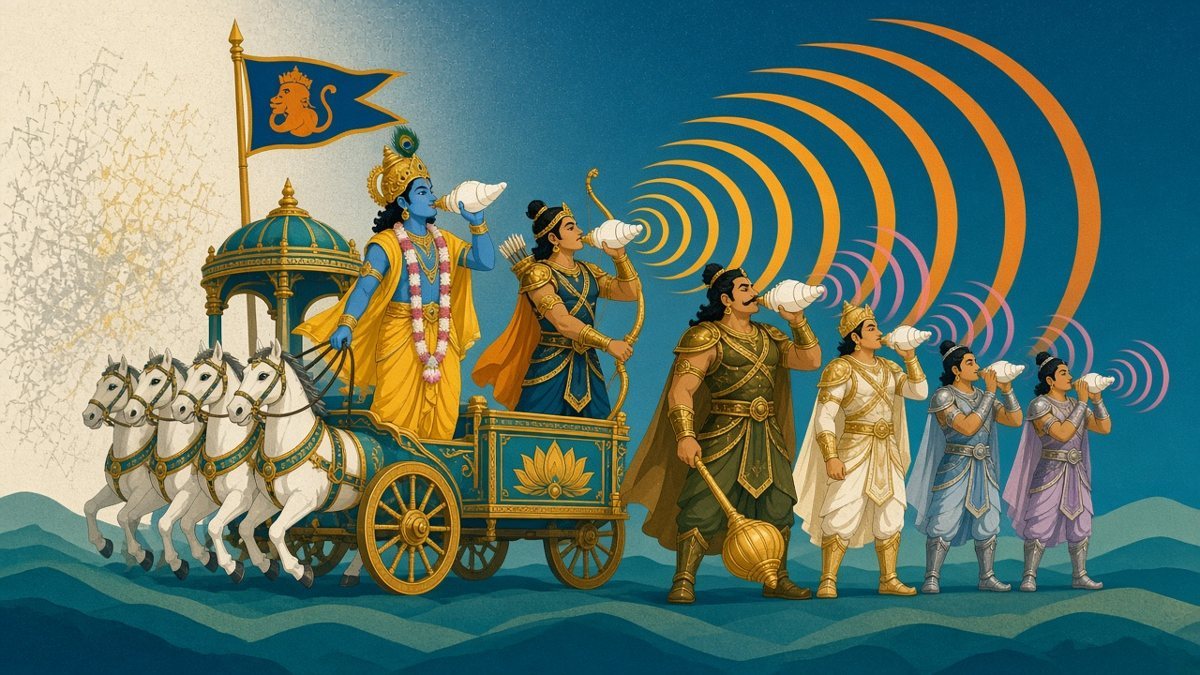
Sañjaya is still telling the blind king Dhṛtarāṣṭra what is happening at Kurukshetra. In the previous reading, Prince Duryodhana finished his anxious speech and the old commander Bhīṣma lifted his spirits with a lion's roar and a blast on his conch. Now the whole Kaurava army joins in with a sudden din. Then, from the other side, Krishna and Arjuna answer from their chariot, and the Pāṇḍava brothers sound their conches one after another, each called by name.
The verses
-
1.13
Then, all at once, conches, kettledrums, small drums, big drums and horns were sounded together. The noise they made was a huge, chaotic roar.
Show the SanskritHide the Sanskrit for verse 1.13
ततः शङ्खाश्च भेर्यश्च पणवानकगोमुखाः ।
सहसैवाभ्यहन्यन्त स शब्दस्तुमुलोऽभवत् ॥ १३ ॥tataḥ śaṅkhāś ca bheryaś ca paṇavānakagomukhāḥ
sahasaivābhyahanyanta sa śabdas tumulo 'bhavatSay it
tuh-tuh-huh shun-khaash-chuh bhay-ryush-chuh puh-nuh-vaa-nuh-kuh-go-moo-khaa-haa
suh-huh-sai-vaa-bhyuh-hun-yun-tuh suh shub-dus-too-moo-lo-bhuh-vutWord by word
- tataḥ
- then
- śaṅkhāḥ ca bheryaḥ ca
- conches and kettledrums
- paṇava-ānaka-gomukhāḥ
- small drums, large drums and cow-horn trumpets
- sahasā eva
- all at once, suddenly
- abhyahanyanta
- were struck, were sounded
- saḥ śabdaḥ
- that sound
- tumulaḥ abhavat
- became a tumult, a deafening uproar
-
1.14
Then, standing on their great chariot drawn by white horses, Krishna and Arjuna blew their own divine conches in reply.
Show the SanskritHide the Sanskrit for verse 1.14
ततः श्वेतैर्हयैर्युक्ते महति स्यन्दने स्थितौ ।
माधवः पाण्डवश्चैव दिव्यौ शङ्खौ प्रदध्मतुः ॥ १४ ॥tataḥ śvetair hayair yukte mahati syandane sthitau
mādhavaḥ pāṇḍavaś caiva divyau śaṅkhau pradadhmatuḥSay it
tuh-tuh-huh shvay-tair huh-yair yook-tay muh-huh-ti syun-duh-nay sthi-tau
maa-dhuh-vuh-huh paan-duh-vush-chai-vuh div-yau shun-khau pruh-dudh-muh-too-huhWord by word
- tataḥ
- then
- śvetaiḥ hayaiḥ yukte
- yoked with white horses
- mahati syandane
- on a great chariot
- sthitau
- the two, standing
- mādhavaḥ
- Mādhava, Krishna
- pāṇḍavaḥ ca eva
- and the son of Pāṇḍu, Arjuna
- divyau śaṅkhau
- their two divine conches
- pradadhmatuḥ
- the two blew loudly
-
1.15
Krishna blew the conch called Pāñcajanya and Arjuna blew Devadatta. Bhīma, the wolf-bellied brother known for fearsome deeds, blew his great conch Pauṇḍra.
Show the SanskritHide the Sanskrit for verse 1.15
पाञ्चजन्यं हृषीकेशो देवदत्तं धनञ्जयः ।
पौण्ड्रं दध्मौ महाशङ्खं भीमकर्मा वृकोदरः ॥ १५ ॥pāñcajanyaṃ hṛṣīkeśo devadattaṃ dhanaṃjayaḥ
pauṇḍraṃ dadhmau mahāśaṅkhaṃ bhīmakarmā vṛkodaraḥSay it
paan-chuh-jun-yum hri-shee-kay-sho day-vuh-dut-tum dhuh-nun-juh-yuh-huh
paun-drum dudh-mau muh-haa-shun-khum bhee-muh-kur-maa vri-ko-duh-ruh-huhWord by word
- pāñcajanyam
- the conch Pāñcajanya
- hṛṣīkeśaḥ
- Hṛṣīkeśa, lord of the senses (Krishna)
- devadattam
- the conch Devadatta, “god-given”
- dhanaṃjayaḥ
- Dhanañjaya, “winner of wealth” (Arjuna)
- pauṇḍram
- the conch Pauṇḍra
- dadhmau mahā-śaṅkham
- blew the great conch
- bhīma-karmā
- doer of fearsome deeds
- vṛkodaraḥ
- Vṛkodara, “wolf-belly” (Bhīma)
-
1.16
King Yudhiṣṭhira, son of Kuntī, blew Anantavijaya, and the twins Nakula and Sahadeva blew Sughoṣa and Maṇipuṣpaka.
Show the SanskritHide the Sanskrit for verse 1.16
अनन्तविजयं राजा कुन्तीपुत्रो युधिष्ठिरः ।
नकुलः सहदेवश्च सुघोषमणिपुष्पकौ ॥ १६ ॥anantavijayaṃ rājā kuntīputro yudhiṣṭhiraḥ
nakulaḥ sahadevaś ca sughoṣamaṇipuṣpakauSay it
uh-nun-tuh-vi-juh-yum raa-jaa koon-tee-poo-tro yoo-dhish-thi-ruh-huh
nuh-koo-luh-huh suh-huh-day-vush-chuh soo-gho-shuh-muh-ni-poosh-puh-kauWord by word
- anantavijayam
- the conch Anantavijaya, “endless victory”
- rājā
- the king
- kuntī-putraḥ
- son of Kuntī
- yudhiṣṭhiraḥ
- Yudhiṣṭhira, “steady in battle”
- nakulaḥ sahadevaḥ ca
- Nakula and Sahadeva, the twins
- sughoṣa-maṇipuṣpakau
- the conches Sughoṣa (“sweet-sounding”) and Maṇipuṣpaka (“jewel-flowered”)
Context and commentary
Look at how Sañjaya tells the two sides. The Kaurava answer to Bhīṣma is a crowd of instruments with no names, struck “all at once” into a tumult. The Pāṇḍava answer comes one voice at a time, and every conch has a name. Pāñcajanya is traditionally said to come from the shell of a sea demon, Pañcajana, whom Krishna defeated while rescuing his teacher's son; Devadatta means “god-given” and is usually said to be a gift to Arjuna from the god Indra; Anantavijaya means “endless victory”. The epithets matter too. Mādhava links Krishna to the Madhu clan (some readers hear “husband of Lakṣmī” in it), and Hṛṣīkeśa is often explained as “lord of the senses”, a hint of the inner mastery he will teach later. Arjuna is Dhanañjaya, “winner of wealth”, a name from his earlier conquests, and Bhīma is Vṛkodara, “wolf-belly”, for his famous appetite and strength. Many readers take the named, “divine” conches as a quiet sign of where Sañjaya's sympathies lie, even though he serves the other king (interpretation). It is also striking that Krishna, who has promised not to fight in this war, sounds his conch first on his side: he is only the charioteer, but he is not neutral. The classical commentators Śaṅkara, Rāmānuja and Madhva pass over these verses quickly, while modern readers who see the battle as an inner struggle sometimes contrast a mind that drowns itself in noise with one whose faculties each speak clearly (interpretation).
Today's lesson
A crowd's noise or your own note
One side answers with a sudden wall of sound that no one in particular made. The other answers one person at a time, each with a conch that has its own name. Neither side has yet thought through what this war will cost; that only begins when Arjuna looks more closely in the next readings. But the contrast is worth noticing. When a group gets swept up together, nobody quite owns the decision, and it can feel like agreement when it is really just volume. Saying something yourself, in your own voice and under your own name, is a different act. It is slower, and it is easier to take responsibility for.
Try this today
Next time you are part of a group decision, whether at work, in a family chat or with friends, notice whether you are adding your own view or just adding to the noise. Before you send the thumbs-up or nod along, say one clear sentence in your own words. For example, if a team is rushing to agree on a deadline in a meeting, instead of a quick “sounds good”, try “I can do it if we drop the extra report; otherwise I need two more days.” Do it once before the day ends.
Get each reading by email
The day's four verses, the lesson and one thing to try. Optional, and separate from new-comic alerts.
One email a day. Unsubscribe from any email.
Check the text and listen
- Verses 1.131.141.151.16Translation and commentary on holy-bhagavad-gita.org
- Public-domain translationsacred-texts.com
- Chapter chanting audio (Sanskrit, downloadable)bhagavad-gita.us
- Verse-level interactive audiomiu.edu